

Identify the injury.
Guide the care.
Strengthen the case.
Objective answers. Appropriate care. Stronger cases.
GMS identifies the diagnostics and imaging needed, reviews the findings, and coordinates referrals to the appropriate specialists — keeping the patient, providers, and attorney aligned throughout the case.
Our Services
Multidisciplinary Clinical Consensus
Multidisciplinary Clinical Consensus
Neurology, Pain Management and Chiropractic. Three specialists, 28+ years of experience each.
Objective Neurodiagnostics
Objective Neurodiagnostics
VNG, EDX and CLIE. Clear findings to identify injury and guide care.
Comprehensive Clinical Case Management
Comprehensive Clinical Case Management
Diagnostics, imaging and specialist coordination. Identifying gaps and coordinating the path forward.
How can we help?
I'm an Attorney
Describe the case and get appropriate testing recommendations from our specialists and guidance for the case.
I'm a Physician
Refer a patient for objective neurological testing. We schedule, work with the attorneys and return an actionable report to you promptly.
I'm an Injured Patient
Hurt in an accident and don't know where to start? Let us help you get answers for your injury, direct your care and support your case.
Quick Case Screening
Provide general, non-identifying details about the injury. Please do not include the client's name, date of birth, contact information, or other protected health information.
Refer a patient to GMS
Provide the information below so GMS can contact the patient directly, complete the intake process, coordinate the appropriate diagnostic evaluation, and keep your office informed.
Please securely upload or fax any available records that may assist with the evaluation — office notes, imaging reports, prior diagnostic findings, and referral orders. Records do not need to be submitted before completing this referral request.
GMS will contact the patient within one business day to begin the intake and scheduling process. We will confirm receipt of the referral and keep your office informed of the patient's progress.
New patient — demographics & injury history
Tell us how to reach you and what happened. If this is a medical emergency, call 911. This is not medical or legal advice — a GMS team member will follow up.
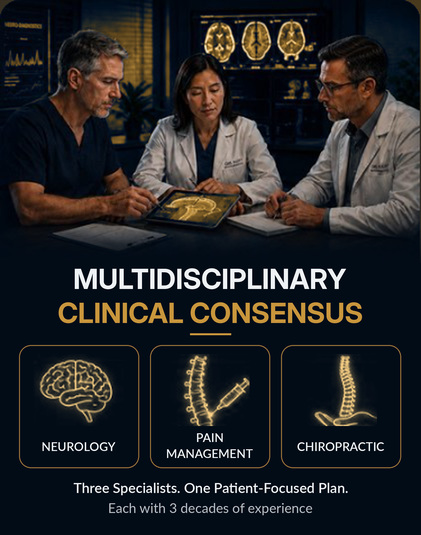
Three specialists. One coordinated clinical plan.
Every injury case is reviewed by an experienced neurologist, pain management physician, and chiropractor — each with more than 28 years of clinical experience.
Together, they assess the complete clinical picture
- Injury mechanism and symptoms
- Treatment and specialist care already received
- Existing diagnostic reports and imaging
- Potential gaps in diagnostics or care
Collaborative diagnostic recommendations
The three specialists collaborate and agree on the diagnostic evaluations appropriate for the patient. Recommendations may include:
GMS performs its specialized neurodiagnostic evaluations and coordinates outside imaging or testing when needed.
Results reviewed together
Once the diagnostic reports are received, the GMS clinical team reviews the findings collectively and determines which specialist consultations may be appropriate. Recommendations may include referrals to:
Relevant findings, recommendations, and applicable precautions or restrictions are documented and communicated to the receiving specialists and, when authorized, the patient's attorney.
One team. One direction. Everyone informed.
This collaborative approach provides:
- More complete diagnostic guidance
- Better-coordinated specialist care
- Fewer gaps and unnecessary delays
- Stronger clinical documentation
- Clear communication among the patient, providers, and attorney
Experienced specialists working together to identify the injury, guide the care, and strengthen the case.
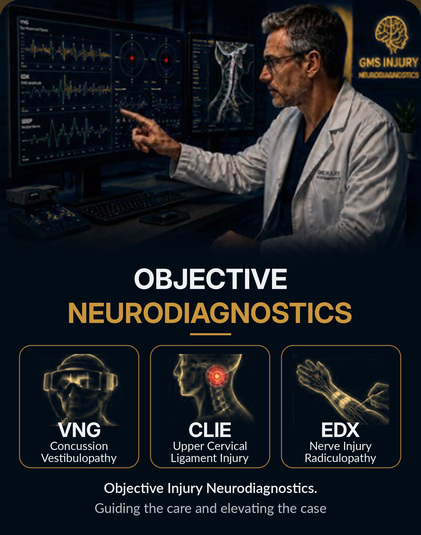
The right test for the right clinical question.
No single test identifies every injury. GMS evaluates the injury history, symptoms, care already received, and existing findings to determine which diagnostic studies are clinically appropriate.
GMS performs VNG, EDX, and CLIE evaluations and coordinates imaging (MRI, CT, X-ray) and other necessary testing when indicated.
Tests GMS performs
Vestibular and neurological evaluation
VNG objectively evaluates eye movements and vestibular function. Following head or whiplash trauma, it may document central or peripheral vestibular abnormalities associated with concussion/mTBI, traumatic vestibulopathy, dizziness, vertigo, and balance dysfunction.
The findings can help define the extent of vestibular involvement and guide rehabilitation, specialist referral, treatment recommendations, and follow-up evaluation.
Upper cervical ligament injury evaluation
CLIE evaluates clinical and functional findings associated with injury to the upper cervical stabilizing ligaments following whiplash or other trauma.
The findings help determine whether additional imaging, cervical stabilization, treatment precautions, follow-up evaluation, or specialist consultation may be appropriate.
Nerve and muscle evaluation
EDX, including nerve conduction studies and EMG, objectively evaluates nerve and muscle function. It can identify and localize cervical or lumbar radiculopathy, peripheral nerve injury, entrapment neuropathy, and other neuromuscular abnormalities.
The results help establish the location and clinical significance of neurological involvement and guide treatment, injections, specialist referral, and follow-up care. When performed early enough, it may be able to establish or rule out pre-existing injury.
Imaging GMS coordinates
Detailed soft-tissue imaging
MRI provides detailed imaging of the brain, spinal cord, discs, ligaments, nerves, and other soft tissues. It may identify structural injuries that cannot be adequately evaluated by standard X-rays or CT.
MRI is important when neurological deficits, persistent symptoms, or suspected soft-tissue injuries warrant further investigation. A normal brain MRI, however, does not rule out concussion.
Alignment, motion, and bony injury
X-rays evaluate fractures, spinal alignment, joint spacing, and degenerative changes. When clinically appropriate, weight-bearing, open-mouth, and flexion-extension cervical views may provide additional information concerning alignment or abnormal motion following trauma.
These findings may help determine whether additional imaging, treatment restrictions, stabilization, or specialist referral is needed.
Acute trauma and bony detail
CT provides rapid, detailed imaging and is particularly valuable for detecting acute fractures and intracranial bleeding following trauma.
It is commonly used when urgent structural injury must be ruled out, although it is less sensitive than MRI for many ligament, disc, spinal cord, and other soft-tissue injuries. CT is not used by itself to diagnose concussion.
Why objective diagnostics matter
Objective findings help:
- Identify injuries that may otherwise be overlooked
- Support clinical causation
- Guide appropriate treatment and specialist care
- Document the extent of neurological or structural involvement
- Establish a clearer and more complete medical record
Better diagnostic information leads to better-informed care — and a stronger clinical foundation for the case.

The right testing. The right specialists. The right time.
Many injury cases are never fully evaluated. The patient may see only one type of provider, necessary imaging may be delayed or overlooked, objective neurodiagnostic testing may never be performed, and appropriate medical specialists may not become involved.
When injuries are not identified early, the consequences affect everyone
- The patient may not receive the care they need
- Treating providers may be working without the complete clinical picture
- Important neurological or structural injuries may be overlooked
- The case may be evaluated as a routine soft-tissue injury rather than according to its true documented complexity
GMS manages the clinical side of the injury case — from the initial screening through diagnostics, specialist coordination, and follow-through.
A complete clinical strategy
- 1
Comprehensive injury screening
GMS reviews the injury mechanism, immediate and current symptoms, care already received, existing diagnostic findings, and providers involved.
- 2
Identification of diagnostic and care gaps
We assess what has been completed, what may have been missed, and what additional evaluation may be appropriate.
- 3
Diagnostic and imaging coordination
GMS performs its specialized neurodiagnostic evaluations and coordinates appropriate outside studies when indicated, including:
VNGCLIEEDX (NCV/EMG)MRICTX-ray - 4
Multidisciplinary clinical review
A neurologist, pain management physician, and chiropractor — each with nearly three decades of experience — collaborate on diagnostic and specialist recommendations.
- 5
Appropriate specialist referrals
Based on the history and objective findings, GMS coordinates consultations with appropriate specialists, which may include:
NeurologyPain ManagementOrthopedicsChiropracticPhysical TherapyOther indicated specialties - 6
Communication and follow-through
Recommendations, diagnostic findings, referrals, and applicable precautions are documented and communicated to the treating providers and, when authorized, the attorney's office. GMS continues to follow the clinical case so important recommendations are not simply made — they are addressed.
Why GMS clinical case management matters
A clearer path forward
A clearer path to the proper diagnostic testing, appropriate specialists, and coordinated care — without being left to determine the next step alone.
A complete clinical picture
Objective findings, multidisciplinary support, and appropriate specialist involvement to help guide a more informed and complete care plan.
Documentation that holds up
Earlier identification of overlooked injuries, stronger medical documentation, appropriate specialist support, and a clinical case developed around the full extent of the patient's documented condition.
Better care. Better coordination. Stronger cases.
GMS helps ensure that the patient receives the appropriate clinical attention, treating providers have the information and support they need, and the attorney can present a case supported by comprehensive diagnostics, credible specialists, and clear medical documentation.
One percent changes everything.
Not reduced. Gone.
Maryland is one of the last strict contributory negligence states. If the defense convinces a jury your client was even one percent at fault, the recovery isn't reduced — it disappears entirely.
So they don't argue how badly your client was hurt. They attack the gap before the first documented complaint and call everything “mild” or “pre-existing” — a playbook that beats subjective pain testimony, but not objective, physician-signed findings tied to the mechanism of injury. That's the entire reason GMS exists.
Built to hold up in the clinic and in court.
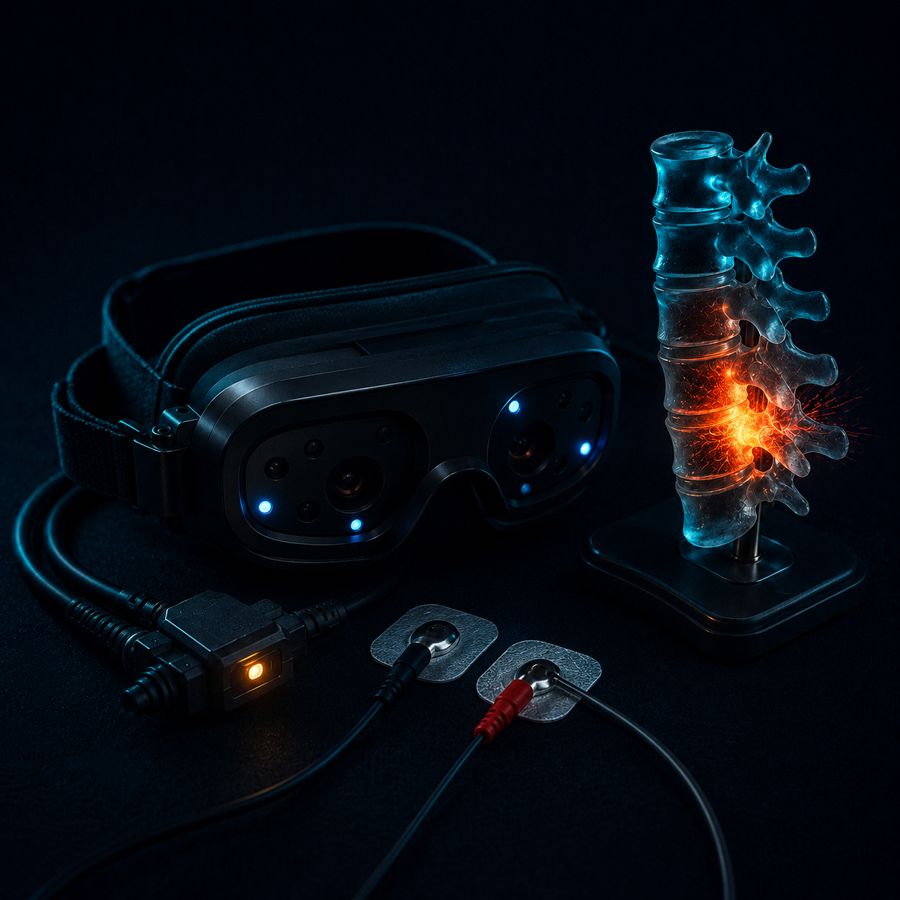
VNG - EDX - CLIE

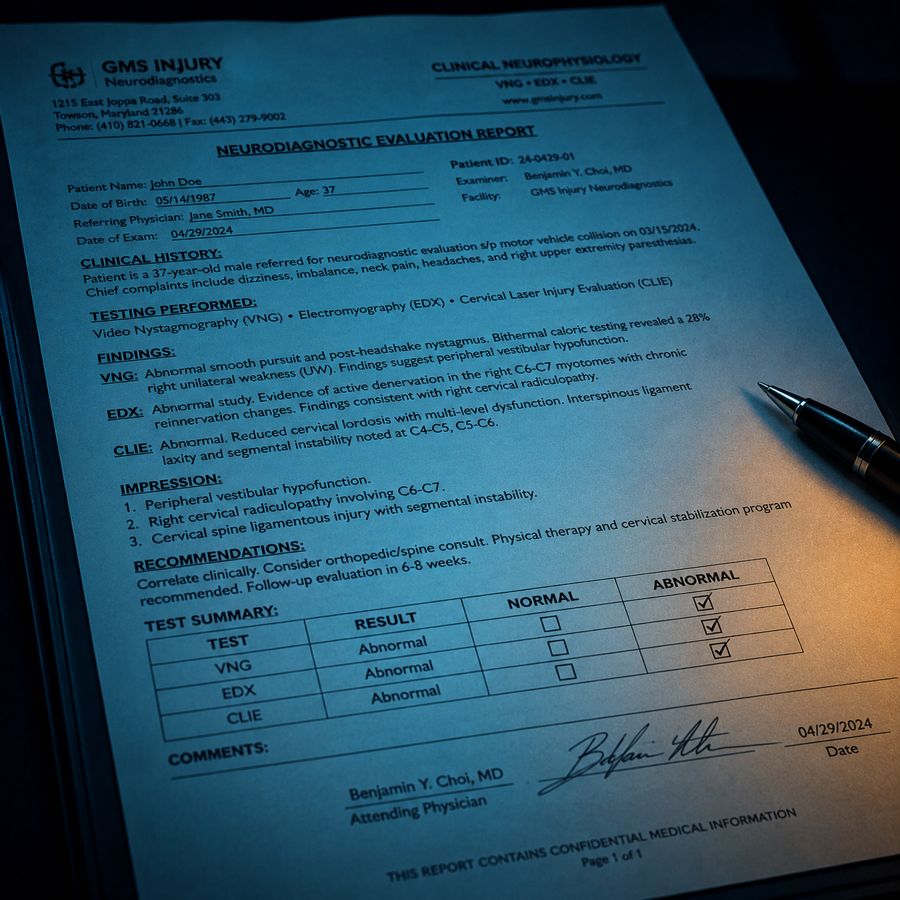
Testing at Towson & Bel Air.
We handle the scheduling, coordinating with attorneys, patients and specialists and provide completed reports promptly.
Identify it. Document it.
Coordinate it.
Screen a case, refer a patient, or get the help you need.
